Civil War Ironclads
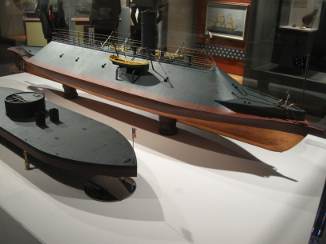
The civil war ironclads were not only unique in the world, the ships developed by the Union and Confederacy were distinctly different. The ultimate test of each design came on March 9, 1862 when the USS Monitor and CSS Virginia met at the battle of Hampton Roads.
|
In 1861, at the outset of the American Civil War the Confederate Navy was a navy on paper only. They had a handful of minor vessels. To have a chance at winning the war, they needed to be bold and make drastic moves since an arms race against the Union Navy would be futile.
In Europe, both France and England had recently launched their first ironclads, the La Gloire and the HMS Warrior. These were both large seagoing vessels that would take years to build. Time the Confederate Navy did not have.
Instead, they opted to develop an ironclad more reminiscent of the floating batteries used with great success by the allies in the Crimean War against the Russians a few years earlier.
A decision was made to convert the sunken hulk of the steam frigate USS Merrimack into the ironclad CSS Virginia. After about a year of work, she was ready to challenge the US Navy, now blockading the inlet to the Chesapeake Bay at Hampton Roads.
It may seem odd to us today, but the work to rebuild the USS Merrimack was followed in great detail by newspapers in both the North and South. The Union decided to create an "ironclad board" made up of three senior officers to settle on a design to oppose the rumored ironclad of the South.
|
The board chose two out of 17 submitted designs. The Ships became the USS Galena and the USS New Ironsides. John Ericsson, the Swedish engineer and industrialist behind the Monitor, was late in submitting his proposed design.
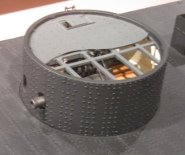
With novelties such as a revolving turret with only two 11-inch Dahlgren guns, and a promise to finish the ship in 90 days, the board accepted. In the end, the USS Monitor was delivered in 119 days, which is still remarkable. At the time, ships typically took a couple of years to complete.
Unique features of Civil War Ironclads
With few exceptions, all civil war ironclads had no sails or rigging. This was new since earlier ironclads were sailing vessels with auxiliary steam power.
New was also the fact that the entire hull, decks and exposed superstructures were armored. The La Gloire and HMS Warrior both had only armor near the waterline and around the armament.
Differences between Union and Confederate Ironclads
Neither the Union or the Confederate States Navy built another ironclad exactly as the Monitor and Virginia, but both stuck to each concepts.
Distinct features of the Union Ironclads:
- One, two or three turrets
- Low freeboard
- Armored deck over an unarmored hull
The low freeboard was a compromise. The price of invulnerability was sub par sea-keeping abilities.
Many navies around the world started to copy the Monitor concept. This particular type of ironclad – with a revolving turret on an armor deck and low freeboard subsequently became known as a <b>Monitor</b>.
Distinct features of the Confederate Ironclads:
- Ram
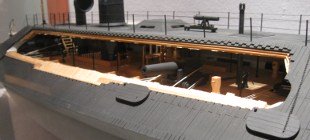
- Guns arranged in armored casemates
- Shallow draft
For the CSN to utilize rams on their ships made perfect sense since their opponent still had many wooden sailing ships on blockade duty.
Building casemates rather than turrets also suited the abilities of the South better. A turret needs a sophisticated steam engine to power it. Building steam engines was beyond their capabilities at the time.
The shallow draft was a lesson learned from CSS Virginia. Her draught of 22 feet made it impossible to bring her to safety upriver. As a result they had to abandon her and set her ablaze.
|
Conclusion of Civil War Ironclads and their Design
The only conclusion one can come to is that the distinctly different designed were optimized for either side's resources and situations.
The fact that the battle at Hampton Roads – the only duel between a single ironclad on either side – came to a draw, proves that both concepts were equally valid.


